

Crossing a state line is an ordinary part of the day for many professional truck drivers. Usually, the change is marked by a sign along the highway, but a handful of U.S. communities make the boundary much harder to separate from everyday life.
In these places, the line can run through downtown, divide opposite sides of a street, or even pass through a building. Bristol, Texarkana, Delmar and Texhoma are four examples where communities developed directly along state borders, creating some unusual arrangements that still exist today.
Bristol, Virginia and Tennessee
Downtown Bristol makes its two-state location impossible to miss. State Street runs along the Virginia-Tennessee boundary, with Bristol, Virginia, on one side and Bristol, Tennessee, on the other. The two are separate cities, but their downtown businesses face one another across the same street.
That means a person can cross from Tennessee into Virginia simply by walking across downtown. For drivers accustomed to state changes happening somewhere along an interstate, Bristol offers a much smaller version of the same transition, with the boundary running directly through the city’s commercial center.
The arrangement grew out of development on both sides of a border that was already in place. Bristol’s early history dates to the 1850s, and the communities eventually developed into the neighboring Virginia and Tennessee cities that share the Bristol name today.
Texarkana, Texas and Arkansas
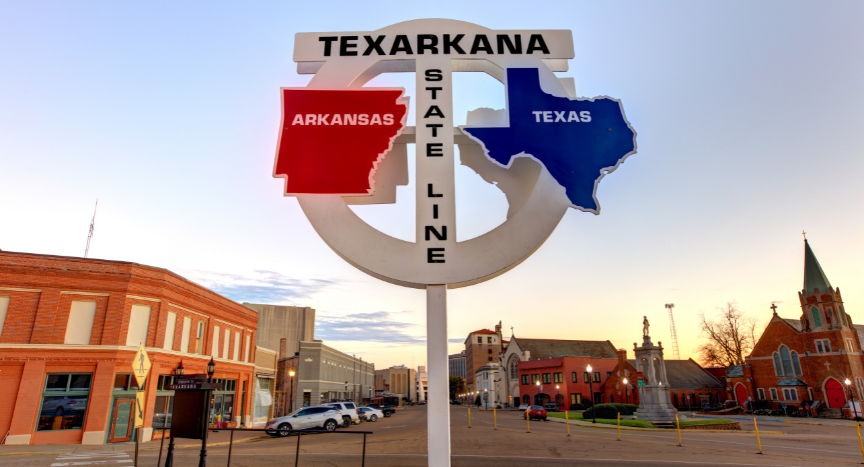
Texarkana takes the idea a step further because the Texas-Arkansas boundary runs through a larger urban area. State Line Avenue follows the border through the community, separating Texarkana, Texas, from Texarkana, Arkansas.
Its best-known landmark shows just how closely the two states meet. The U.S. Post Office and Courthouse in downtown Texarkana was built directly on the boundary, placing the federal property in both Texas and Arkansas.
The cities remain separate municipalities, but the border has not prevented them from sharing some services and facilities. That combination gives Texarkana the appearance of one connected city while addresses, local government, and state jurisdiction change depending on which side of the line a person is on.
For truck drivers, Texarkana may be the most familiar community on this list because several major freight routes converge in the area. Passing through can feel like traveling through a single transportation hub even though the cityscape extends across two states.
Delmar, Delaware and Maryland
Delmar announces its two-state identity in its name. The community combined the first three letters of Delaware and Maryland after developing around a railroad station at the state boundary in the 1800s.
The border runs through the middle of State Street, but Delmar did not develop as a completely divided community. The Delaware and Maryland municipalities have a long history of sharing services, an arrangement that allowed the two sides to operate together without eliminating their separate legal identities.
That cooperation has included infrastructure and community services extending across the line. Residents can therefore share parts of daily life with neighbors on the other side while still living in different states with different state and local jurisdictions.
For someone passing through on U.S. 13, there is little in the surrounding development to suggest how much changes at the boundary. The street continues, and the community continues, even though Delaware ends and Maryland begins.
Texoma, Texas and Oklahoma
Texhoma’s story is different because the location of the state line itself became part of the town’s history. The community developed along the Texas-Oklahoma border after the railroad arrived, and its name combines the two states much like Delmar does with Delaware and Maryland.
A survey in the early 1930s found that the accepted boundary was in the wrong location. The corrected line moved south by roughly 465 feet, which placed most of the business district and the railroad depot on the Oklahoma side.
Texhoma still maintains an unusual connection across the border through its schools. Children from both states are served through a bi-state arrangement in which kindergarten through fourth grade are handled by the Texas district and fifth through twelfth grade by the Oklahoma district.
That makes Texhoma more than another town sitting beside a border. Its residents have spent generations dealing with a boundary that once changed location and still divides local government while education operates across it.
When the State Line Runs Through Town
State borders can seem straightforward on a road atlas, especially to drivers who cross them regularly. Bristol, Texarkana, Delmar and Texhoma show how different those lines can look once homes, businesses and public services develop around them.
Each community has handled its location differently. Bristol shares a downtown street, Texarkana grew into a connected urban area, Delmar built a history of shared services, and Texhoma created cross-border arrangements after an unusual boundary correction.
For professional drivers who spend their careers moving between states, these towns offer a different perspective on something normally experienced at highway speed. In each one, entering another state can take no more than crossing a street.
FAQ
Are these actually single towns located in two states?
Not technically in most cases. Bristol, Texarkana, Delmar, and Texhoma have separate municipal jurisdictions on either side of their respective state boundaries, even though each pair shares a name or strong community identity.
Are there other U.S. communities divided by state lines?
Yes. Bluefield, Virginia, and Bluefield, West Virginia, are neighboring communities with the same name, while Union City, Indiana, sits beside Union City, Ohio. The way the boundary interacts with the community differs from place to place.
Can a state boundary run through private property?
Yes. State boundaries do not have to follow individual property lines, and Delaware’s historical records document situations in which its boundaries pass through private properties. Those circumstances can affect issues such as taxation, voting, and school jurisdiction.
Can an established state line really be corrected?
Yes, particularly when later surveying identifies a problem with an earlier boundary survey. Texhoma is an especially notable example because the 1932 correction shifted the recognized Texas-Oklahoma boundary hundreds of feet south of the line previously used by the community.